In late January, there was a rare gathering of friends from all across Ontario and Quebec. We managed to squeeze in almost a full 48 hours together before the grown-ups had to return to their jobs and the "adult children at home" had to get back to their fruitless job hunting. It was a magical weekend; we often see one another one-on-one, but for almost the whole gang to be in the same room again was intensely special.
We weren't what I'd call a "dorky" crew during our undergrad days; sure, we did well at school, but we also drank like fish and smoked and passed out in weird places and dated hot heart-breakers. Normal BA stuff.
But as we sat around in my bud's living room, getting progressively drunker on cheap beer and even cheaper wine, the conversation - which had started with normal catching up- quickly took on a literary tone.
It was probably one of the most genuine, enthusiastic talks I've ever had with this group and that's saying something, because this crew consists of some of my very best friends. Everybody- guys and girls- just wanted to talk about what they were reading now, what they'd read back then, which books were going to make great movies, and what they'd write if they had the chance. Keep in mind, only one of us there (me) is a self-identified "writer". We were a motley crew of history majors, education majors, sociology & poli-sci double majors and one long English major. Who woulda thunk we'd come together over books?
Anyway, the drinks kept flowing and some revelations were revealed. Apparently, a lot of us used to write when we were younger. I didn't share with the gang that I had just recently tossed all my high school notebooks, including the 350 hand-written page notebook.
But at some point between the fourth and fifth glasses of Red, one of my adorable teacher friends piped up: "Hey! We should all write novels in February!"
And so a pact was made: we would each shoot for 1,000 words a day, from February 1-28th, resulting in a short novel approximately 28,000 words long. At the end of the month, we'll share our novels with each other. So I should have four novels to read by month's end.
We're now seven days into February and most of us admittedly are rather behind. Personally, I only have about 1,300 words so far. BUT I'm loving actually writing again. My brain is constantly churning, searching for inspiration, filing away ideas for later... it's like a winter miracle. In fact, I'm rushing this post a little so that I can procrastinate on job hunting and get writing again! I might even enter the draft in a contest or something, if it holds up after editing. If not, at least I got my writer's mojo back.
If you want to write a February Novel: it's not too late!
1. Don't waste time comparing ideas, paralyzed by the thought of "choosing the wrong one". Just pick something and go with it. I was afraid to write a cop novel because I thought I was limiting myself with the genre. I was also worried about writing something that the guys wouldn't want to read. That was just an excuse to not get started earlier.
2. Just write; don't edit. Some people are getting bogged down thinking their words are crap-- that's not the point of the exercise. In this case, we really are going for quantity not quality. Because as a writer, you're your own worst enemy.
3. Set a reasonable goal, like say 500 words a day. Don't beat yourself up if you miss a day-- and don't stop if you're on a roll!
4. Do it with someone! A lover, a friend, your book club. You'll need someone to hold you accountable, and I am literally SO STOKED to read my friends' novels. This is definitely a project that's meant to be shared.
5. Tweet, instagram, pin and let us know how your own #FebruaryNovel is coming along.
Gotta book it
xox
JEM
Showing posts with label career. Show all posts
Showing posts with label career. Show all posts
Friday, 7 February 2014

Monday, 13 January 2014
What's in a Name?: To Change or Not to Change your Last name in the Twenty First Century
In Undergrad my roommate and I were talking one afternoon
(as we did many, many wonderfully lazy afternoons) and realized we had no idea how
our parents got engaged. We called them to find out. To our great
disappointment both of our parents had very unexciting stories. Her parents
were watching TV and “decided” to get engaged. My parents were on a walk. They
both made very gender equal, seriously mutual decisions and they both picked out their own rings. As members of
generation-Notebook we were horrified.
Luckily, my own engagement was exactly what I wanted. Quiet, cute and a total surprise. The
fact that we are getting married isn’t a surprise to me, I’ve always known that
he’s the one, but the timing was. I had NO clue we were “there” yet or that he
had any kind of plan percolating. Now, despite being a self-coined member of "generation-Notebook" (and I'm quite sure Allie took Noah's last name) I am pretty adamant about the name change debate. I am not going to take his last name. I'm not going to hyphenate. I'm not even going to think about it. My mom
didn’t take my dad’s last name and its been something I've always honoured and respected. My mom’s best friend’s kids even took HER last name
instead of her common-law husband’s. I was raised by feminists and I am a
feminist. I have never considered taking
someone else’s name. I certainly never doodled Mrs. Timberlake or Mrs. Hanson in my
notebook as a young girl. It's always been a non-issue for me. Even my younger brother asked me tentatively "are you going to take his last name?" with hope that I wouldn't in order to remain true to myself and they way that we were raised.
When my boyfriend’s brother got married two years ago we
discussed how his sister-in-law took their last name. My boyfriend said something offhand
like: “I’m pretty traditional about that”. In a fleeting moment of attempted male dominance he reverted back into a caveman before my very eyes. I looked him in the eye and simply
said “well, you’ll have to marry someone else then”. I was serious. I know; I
am a cold hearted bitch sometimes. I kind of love it. And obviously, so
does he. He proposed knowing that the last name issue is a deal breaker
for me and is something that he has decided he can live with. He even said it somewhat proudly to his friends the other night. I realize I'm making him sound like a bit of an old fashioned ass here and he's not. He's kind and loving and very accepting. However, it's a reality that many men still think we should take their last name. Whether it's their romantic side coming out, an attachment to old traditions or simple=y their neanderthal brains coming into play; it's something many women will have to deal with when they say they want to keep their last name. But here's the thing: if I said I'll take his last name I’d be changing me and I wouldn’t want to be that woman
or wife.
All that said; it’s still a personal
choice. And yes, while I judged the girls on facebook that got married
straight out of high school and changed their last names on social media faster
than they could get out of their wedding dresses, I can accept that changing their last name is a choice
many women make and one that many women would adamantly defend! I realize that not everyone's mother is a feminist. And just like I'm not willing to change my stance I don't expect other women to change theirs. I actually recently saw a cute wedding picture on Pinterest that said : “he stole my heart
so I stole his last name”. I can understand the logic; you love this person so much and want to be able to have a mailbox that says "The Bakers". You don't want to have two last names that are so long they don't even fit on your passport like me (I have mom & dad's last names). You want your last name to be the same as your kid's. You don't want to constantly have to correct people at the bank or the airport. I get it.
 |
| Source: Pinterest |
Buuuut, if you need more information to make your decision you've come to the right place! I've scoured the internet for interesting tidbits on the subject. For example, I found Lucy Stone. I credit my not knowing who she is to the fact that in Canada we have many of our own badass early feminists (Nelly McClung, Charlotte Whitton etc.).
 |
| Lucy Stone Source: Pinterest |
Lucy Stone, born in 1818, dedicated her life to improving life for American women through a dedication to the Women's National Loyal League, American Equal Rights Association and as President of the New Jersey Woman Suffrage Association. She was also an abolitionist who fought against slavery with her parents from a young age and worked with the American Anti-Slavery Society later in life. She pursued higher education against her parent's wishes and after a lot of a hard work and dedication (in a very unequal Academic arena) became the first woman from Massachusetts to earn a bachelor's degree. In 1850, she organized the first national Women's Rights Convention. When she married Henry Blackwell in 1855, Stone was the first woman to keep her maiden name after marriage and proclaimed their wedding: "a wife should no more take her husband's name than he should hers, my name is my identity and must not be lost". They had a daughter in 1857 named her Alice Stone Blackwell. Biography.com sums of her life powerfully by stating: "while Stone did live to see the end of slavery, she died 30 years before
women were finally permitted to vote (August 1920), on October 18,
1893, in Dorchester, Massachusetts". (Biography) Heartbreaking, inspiring and a very powerful argument for keeping your maiden name.
What else did I find on the internet about women keeping their own last name? I'll tell you! I found a bunch of conflicting statistics, some idiot men's comments on the subject and all in all no conclusive answer about the current trends in keeping/changing last names.
PS Mag has an article on the subject (written by a man) with some interesting statistics from around the world. Interestingly, the author doesn't associate women keeping their last name with a resurgence of feminism in the twenty first century:
PS Mag has an article on the subject (written by a man) with some interesting statistics from around the world. Interestingly, the author doesn't associate women keeping their last name with a resurgence of feminism in the twenty first century:
"but while some 35 percent
of American women in their 20s and 30s are now choosing to keep their
own names, that doesn’t necessarily have anything to do with a
“resurgence of feminism,” interesting as that would be. While retaining
one’s maiden name upon marriage has historically been pretty closely
affiliated with feminism, it’s also a sign that, for a lot of women,
adult identity is now already established well before getting wed" - PS Mag
I find it interesting how Daniel Luzer separates having an "adult identity" from feminism, when to me women having an identity whether it be sexual, physical, spiritual, financial or otherwise, is directly correlated to the roots of feminism. Isn't having an identity exactly what Lucy Stone was talking about when she said "my name is my identity and must not be lost"? He also uses the term "low-level feminists" which I find problematic but I also know the "F"-word has a bad rap with a lot of women. The article surmises that overall the older the bride and the better her job the more likely she is to keep her last name.
Apparently keeping your last name raises a whole bunch of issues after the wedding. Banks, insurance and relatives all start automatically changing your last name for you. Yikes. There's even a wikihow about how to tell people you're keeping your name.
Interestingly, Womens Health Magazine has stats that say "more than one in four brides want to keep or at least hyphenate their last names, according to a new survey from WeddingDays.co.uk, a UK wedding directory." The magazine then did some research from an American standpoint that said "just 8 percent of married women have decided to keep their last names (while about 6 percent either hyphenate or modify their last names in some other way), according to a 2011 survey from The Knot". The actual statistics have gone from 23% in the 90s to 18% in 2000.
Mens Health Magazine did their own poll and found that 63.3 percent of Men’s Health followers said they would be upset if their wives kept their maiden names. I've selected some of the quotations that they published in the article for your reading pleasure:
“Hyphenation is a direct “f*ck you” to a man’s masculinity… it elevates his father-in-law’s manhood over his own.” —Anonymous respondent, via a SurveyMonkey poll
“It sounds like she’s trying to hang onto her “single person” identity and not identify with the fact that she’s married now.” —Anonymous respondent, via a SurveyMonkey poll
Oh, but it gets better: 96.3 percent of Men’s Health followers said they wouldn’t take a woman’s last name if she asked them to.
“My name is part of who I am.” —Anonymous respondent, via a SurveyMonkey poll
COUGH, COUGH. Um hello? Just a LITTLE bit hypocritical.
Obviously, in this day and age if you read any comments section under any article you see a broad spectrum of opinions ranging from right to left and I've strategically selected the most idiotic and offensive ones I could find for the sake of this blog post. But still.
The Daily Mail found that "the proportion of women who opt to hold on to their maiden name is highest among those in their 20s" and that "Rachel Thwaites from the University of York, said that the statistics showed younger women were increasingly identifying themselves as feminists".
But it's not just about being a feminist. It's about education, employment and careers too. I want the name on my Master's degree to be my current last name. I worked hard for that piece of paper! When I publish my first book I want it to have that same name on it.
The Globe & Mail writer Wendy Leung quotes research from The Netherlands that found "women who take their partner's name are regarded as more caring but less intelligent, less competent and less ambitious, researchers from the Netherlands discovered". Leung also found that "in a four-part study titled "What's in a Name?", social psychologists at Tilburg University found that Dutch women who adopted their partner's name actually possessed different characteristics than those who kept their own, supporting previous U.S. research".
The last snippit of information/findings I will share with you comes from Facebook, a questionable source in terms of reliability, but interesting nonetheless. The Huffinton Post states "in partnership with The Daily Beast, Facebook looked at the names of 14 million married females, ranging in age from 20 to 79 who are currently active on Facebook and married in the United States, according to a report on The Daily Beast Thursday. Facebook determined that of that group, 65 percent of women in their 20s and 30s changed their names".
Well, that's all I've got. Think about it. Comment. Tweet us. What do you think? If you changed your last name we want to hear from you too!
Gotta book it; JEM.
Interestingly, Womens Health Magazine has stats that say "more than one in four brides want to keep or at least hyphenate their last names, according to a new survey from WeddingDays.co.uk, a UK wedding directory." The magazine then did some research from an American standpoint that said "just 8 percent of married women have decided to keep their last names (while about 6 percent either hyphenate or modify their last names in some other way), according to a 2011 survey from The Knot". The actual statistics have gone from 23% in the 90s to 18% in 2000.
Mens Health Magazine did their own poll and found that 63.3 percent of Men’s Health followers said they would be upset if their wives kept their maiden names. I've selected some of the quotations that they published in the article for your reading pleasure:
“Hyphenation is a direct “f*ck you” to a man’s masculinity… it elevates his father-in-law’s manhood over his own.” —Anonymous respondent, via a SurveyMonkey poll
“It sounds like she’s trying to hang onto her “single person” identity and not identify with the fact that she’s married now.” —Anonymous respondent, via a SurveyMonkey poll
Oh, but it gets better: 96.3 percent of Men’s Health followers said they wouldn’t take a woman’s last name if she asked them to.
“My name is part of who I am.” —Anonymous respondent, via a SurveyMonkey poll
COUGH, COUGH. Um hello? Just a LITTLE bit hypocritical.
Obviously, in this day and age if you read any comments section under any article you see a broad spectrum of opinions ranging from right to left and I've strategically selected the most idiotic and offensive ones I could find for the sake of this blog post. But still.
The Daily Mail found that "the proportion of women who opt to hold on to their maiden name is highest among those in their 20s" and that "Rachel Thwaites from the University of York, said that the statistics showed younger women were increasingly identifying themselves as feminists".
But it's not just about being a feminist. It's about education, employment and careers too. I want the name on my Master's degree to be my current last name. I worked hard for that piece of paper! When I publish my first book I want it to have that same name on it.
The Globe & Mail writer Wendy Leung quotes research from The Netherlands that found "women who take their partner's name are regarded as more caring but less intelligent, less competent and less ambitious, researchers from the Netherlands discovered". Leung also found that "in a four-part study titled "What's in a Name?", social psychologists at Tilburg University found that Dutch women who adopted their partner's name actually possessed different characteristics than those who kept their own, supporting previous U.S. research".
The last snippit of information/findings I will share with you comes from Facebook, a questionable source in terms of reliability, but interesting nonetheless. The Huffinton Post states "in partnership with The Daily Beast, Facebook looked at the names of 14 million married females, ranging in age from 20 to 79 who are currently active on Facebook and married in the United States, according to a report on The Daily Beast Thursday. Facebook determined that of that group, 65 percent of women in their 20s and 30s changed their names".
Well, that's all I've got. Think about it. Comment. Tweet us. What do you think? If you changed your last name we want to hear from you too!
Gotta book it; JEM.
Sunday, 12 January 2014
Liar Liar...English Hire?!
So a couple of weeks ago, something incredible happened. My heart was pounding, my eyes widened as my sense of hope elevated and my mouth seemed frozen open as though stuck on the "O" of "O-M-G". No, I didn't see my true love at first site, and no, it wasn't really good porn. It was a simple article on Facebook, entitled "Why English Majors are the hot new hires" which I have posted here for your viewing pleasure.
https://www.openforum.com/articles/why-english-majors-are-the-hot-new-hires/
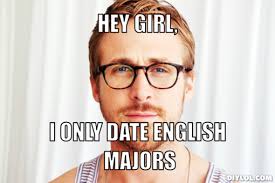
My reaction to the article occurred in stages. First, was the excitement at seeing the title and thinking "Yes! Someone is finally realizing my worth! Employment here I come!" Then I actually started reading the article. Bruna Martinuzzi, the author of the article, makes some valid points about the often underrated qualities and qualifications that English majors bring to the table. Things like excellent communication and writing skills, and a strong hand in critical thinking. While I would argue, slightly biased of course, that English majors undergo the most rigorous training in critical thinking of all the liberal arts majors, the reality is that critical thinking, along with the other skills Martinuzzi lists, is not limited to the English major alone. In fact, the entire arts spectrum underscores the importance of logical argumentation and clear, concise communication, so the article's claims for English majors could as easily be made for History, Philosophy, Sociology and Political Science as well. Furthermore, the social science disciplines actually have one-up on us arts students in the research department, as they are required to take statistics courses which only augment employers' confidence in their ability to research and analyze material.
 And here's another kicker (and where my original excitement downspirals into cynicism). Any of the jobs I have applied to that list "excellent written and oral skills" or "editing and proofreading" among its ideal applicant's key qualifications second these skills to a very specific education, often including a degree in Communications or Journalism; even a Business Administration degree is requested for the most menial of jobs! The skill set Martinuzzi lists appears after these very specific qualifications, which leads one to wonder which of the two will be considered more favorably by the employer. Will it be enough that I am an excellent communicator with years of experience editing and writing for professionals, but I'm also an English major? Or would they rather have a Business Admin degree, even if that means having to look over every article produced to ensure our dependable business student used the correct "there" in their writing?

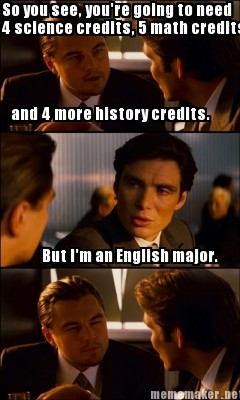
What's worse is the reality that it does not necessarily have to be one or the other anymore. Nowadays, good writing practices are being more emphasized across the social sciences and even outside the liberal arts discipline. Many science students are required to take an English Literature course and, having served as a teaching assistant for one of those courses recently, I can attest to the fact that despite a science or engineering background, many non-arts students write with the capability of those of us who specialize in the art of communication and argumentation. An English major alone is rarely enough to satisfy. Those job postings that require "excellent communication and written skill" always come with an additional caveat that run-of-the-mill English majors may not be able to fulfill. Want to edit stories for the news? You need excellent communication skills AND a degree in television broadcasting. Want to work as a research assistant? You need thorough research skills AND demonstrated experience in statistics. An English major alone is realistically insufficient.
Ultimately, it saddens me to say that Martinuzzi's article fails to answer the "why" question. Why hire an English major, specifically, when there are all sorts of other disciplines out there that arm students with similar skills and qualifications? The dreamer in me wants to believe that she is right, that there is something special and unique about those of us who study literature, with which other arts programs simply cannot compare. But the truth of the matter is, the title of the article could just have easily read "why arts majors are the hot new hires", hitting home the reality that despite any corporate move towards the arts, we still have an outrageous number of equally qualified candidates to compete against for the ever decreasing number of jobs available.
In the mean time, we struggle onwards with the hope of finding employment that will motivate us to get up every morning and do our best, while maintaining the reassurance that even if we are "merely" English majors, at least we have one hell of a library.
https://www.openforum.com/articles/why-english-majors-are-the-hot-new-hires/
My reaction to the article occurred in stages. First, was the excitement at seeing the title and thinking "Yes! Someone is finally realizing my worth! Employment here I come!" Then I actually started reading the article. Bruna Martinuzzi, the author of the article, makes some valid points about the often underrated qualities and qualifications that English majors bring to the table. Things like excellent communication and writing skills, and a strong hand in critical thinking. While I would argue, slightly biased of course, that English majors undergo the most rigorous training in critical thinking of all the liberal arts majors, the reality is that critical thinking, along with the other skills Martinuzzi lists, is not limited to the English major alone. In fact, the entire arts spectrum underscores the importance of logical argumentation and clear, concise communication, so the article's claims for English majors could as easily be made for History, Philosophy, Sociology and Political Science as well. Furthermore, the social science disciplines actually have one-up on us arts students in the research department, as they are required to take statistics courses which only augment employers' confidence in their ability to research and analyze material.
What's worse is the reality that it does not necessarily have to be one or the other anymore. Nowadays, good writing practices are being more emphasized across the social sciences and even outside the liberal arts discipline. Many science students are required to take an English Literature course and, having served as a teaching assistant for one of those courses recently, I can attest to the fact that despite a science or engineering background, many non-arts students write with the capability of those of us who specialize in the art of communication and argumentation. An English major alone is rarely enough to satisfy. Those job postings that require "excellent communication and written skill" always come with an additional caveat that run-of-the-mill English majors may not be able to fulfill. Want to edit stories for the news? You need excellent communication skills AND a degree in television broadcasting. Want to work as a research assistant? You need thorough research skills AND demonstrated experience in statistics. An English major alone is realistically insufficient.
Ultimately, it saddens me to say that Martinuzzi's article fails to answer the "why" question. Why hire an English major, specifically, when there are all sorts of other disciplines out there that arm students with similar skills and qualifications? The dreamer in me wants to believe that she is right, that there is something special and unique about those of us who study literature, with which other arts programs simply cannot compare. But the truth of the matter is, the title of the article could just have easily read "why arts majors are the hot new hires", hitting home the reality that despite any corporate move towards the arts, we still have an outrageous number of equally qualified candidates to compete against for the ever decreasing number of jobs available.
In the mean time, we struggle onwards with the hope of finding employment that will motivate us to get up every morning and do our best, while maintaining the reassurance that even if we are "merely" English majors, at least we have one hell of a library.
Subscribe to:
Posts (Atom)